
Six Thinking Hats
Decision MakingEveryone thinks about the same thing in the same way at the same time — one hat at a time — instead of arguing from six angles at once.
Most discussions fail for a structural reason rather than a personal one. While one person is listing risks, another is defending the idea and a third is proposing something new. Nobody is wrong. They are simply doing different jobs at the same moment, and the conversation turns into a contest between modes rather than an examination of the thing.
Edward de Bono's Six Thinking Hats fixes that by making everyone wear the same hat at the same time. You still cover every angle — you just stop covering them simultaneously.
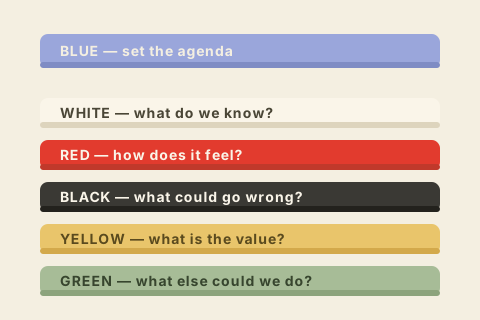
The six hats
- Blue — process. What are we deciding, and how will we run this? Blue opens the session and closes it.
- White — facts. What do we actually know, and what is missing? No interpretation, no opinions dressed as data.
- Red — feelings. Gut reactions, stated without justification. Giving intuition a legitimate slot is what stops it leaking into the other hats disguised as reasoning.
- Black — caution. What could go wrong? The most useful hat and the most overused one.
- Yellow — value. What is the upside, and what would have to be true for this to work well?
- Green — alternatives. What else could we do that nobody has proposed?
The order matters less than the separation, but running Black immediately before Yellow is a common choice: it is easier to find genuine value in an idea once its risks are already on the table and no longer need defending against.
Six hats needs uninterrupted time and a visible clock — it collapses the moment people start half-checking messages. Porotimer runs the block on your iPhone.
Download on the App Store
Why it works
The hats do two things at once, and the second is the one people miss.
Criticism is personal. If you raise a risk, you are the person against the idea, and the argument becomes about your position rather than the risk.
Criticism is assigned. Everyone is wearing black together, so finding a flaw is doing the task, not taking a side — and it becomes equally normal to take the hat off again.
That separation is what lets a sceptic contribute optimism and an enthusiast contribute risk. It is not role-play; it is removing the social cost of changing mode.
The failure mode is theatre. If the hats become a ritual to get through rather than a genuine constraint on what you are allowed to say right now, you have added ceremony without adding thinking.
Practise it on something real
Work through the hats in order, one at a time. The discipline is not answering every box — it is refusing to answer the others while you are in one.
When to reach for it
Reach for it when a group keeps circling, when one voice dominates by temperament rather than argument, or when a decision needs a hearing rather than a debate. It is heavier than most models here, so it earns its cost in groups more than alone — though running it solo is a genuinely good way to notice which hat you always skip.
It pairs with second-order thinking, which is what the black and yellow hats are reaching for when they are done well: not just what could go wrong, but what happens after it does. If the session is really about deciding what to work on first rather than examining one idea, the Eisenhower Box is the faster tool.
More mental models

Strip a problem to what you know is true, then build your answer back up from there.

The event is the tip. Underneath sit the patterns, structures and beliefs producing it — and those are the only levers that change anything.

Instead of asking how to succeed, ask what would guarantee failure — then avoid that. The negative answer is usually far more concrete.