Second-Order Thinking
Decision MakingAsk what happens after what happens. Most bad decisions look good one step out and fall apart at step two.
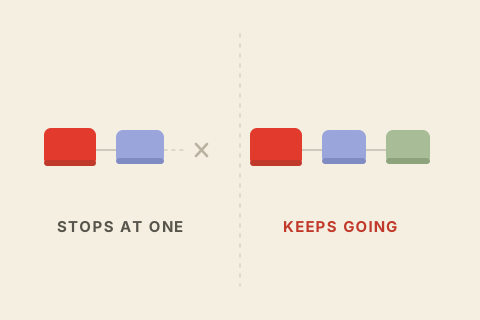
Every decision has an obvious consequence and a set of less obvious ones behind it. First-order thinking stops at the obvious one, because the obvious one is usually the reason you wanted the decision in the first place.
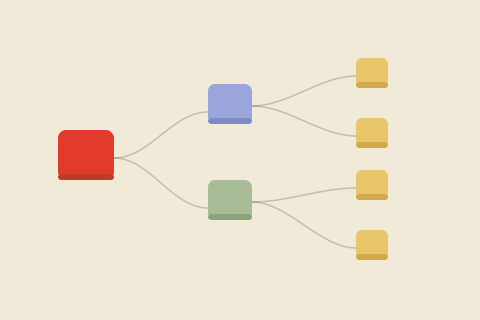
Second-order thinking is the habit of asking and then what? — and then asking it again about the answer.
Why the first answer is usually wrong
In colonial Delhi, the administration wanted fewer cobras, so it paid a bounty for dead ones. First-order effect: people brought in cobras and the population fell. Second-order effect: people started breeding cobras for the bounty. When the scheme was scrapped, the breeders released their now-worthless stock and the city ended up with more snakes than it started with.
Nothing about that outcome required hindsight. It required one more question.
The pattern repeats because first-order effects are the ones you can picture and the ones that arrive soonest, while second-order effects are diffuse, delayed, and usually caused by people reacting to your decision rather than by the decision itself. That last part is the tell: wherever a change alters what behaviour gets rewarded, the interesting effects are downstream.
The method
- Name the decision in one sentence, with no justification attached.
- Write the first-order effect — the one you are hoping for. This is the easy one and it is usually right.
- Ask "and then what?" about that effect. Who reacts to it, and how?
- Ask it again about the answer. Stop when the answers stop surprising you.
Most of the value sits at step four. Step three is often just the first effect restated, and stopping there feels like you have done the work when you have not.
Following consequences three steps out takes quiet you have to defend. Porotimer gives you a focused block on your iPhone — timer, breaks, and a distraction shield.
Download on the App Store
What it looks like in practice
Say a focus app adds a daily streak counter.
Streaks make people come back. Daily active use goes up, retention improves, and the change looks like a clear win in the dashboard.
People protect the streak. Some start logging a token one-minute session at midnight purely to keep it alive. Daily active use still climbs, but the metric has quietly stopped measuring focus and started measuring streak anxiety.
The second-order reading does not necessarily kill the feature. It changes what you would measure to know whether it worked, and it tells you the failure mode to watch for — which is exactly what the first-order reading could not do.
Second-order thinking has a failure mode of its own: run it far enough on any decision and you can talk yourself out of everything. Stop when the answers stop surprising you.
When to reach for it
Use it when a decision changes an incentive, when it is hard to reverse, or when it will be copied — those are the three shapes where the downstream effects outweigh the immediate one. A reversible decision with no incentive attached rarely repays the effort; make it and watch what happens instead.
It pairs naturally with first principles thinking: one asks whether your reasoning starts from something true, the other asks where that reasoning ends up. And if the decision you are weighing is really about what to do first rather than what to do at all, the Eisenhower Box is the better tool.
Try it on a decision
The first effect is the one you already expect. Keep going — the ones worth finding are further down.
More mental models

Strip a problem to what you know is true, then build your answer back up from there.

The event is the tip. Underneath sit the patterns, structures and beliefs producing it — and those are the only levers that change anything.

Instead of asking how to succeed, ask what would guarantee failure — then avoid that. The negative answer is usually far more concrete.