
Inversion
Problem SolvingInstead of asking how to succeed, ask what would guarantee failure — then avoid that. The negative answer is usually far more concrete.
Ask someone how to have a productive year and you get platitudes. Ask them what would guarantee an unproductive one and the answers arrive immediately, in detail, and in the first person.
That asymmetry is the whole model. The mathematician Carl Jacobi's advice was invert, always invert: when a problem resists a direct answer, solve its opposite and work backwards.
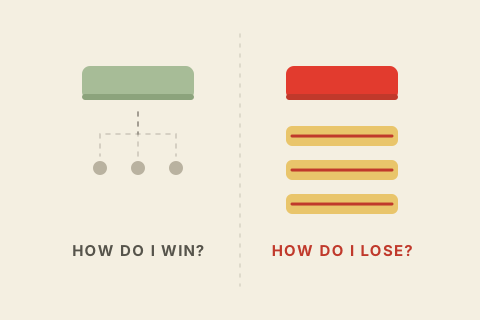
Why the negative question is easier
"How do I do great work?" has no edges. Any answer is defensible, none is actionable, and the vagueness feels like depth.
"What would stop me doing great work?" has edges everywhere: too many meetings, no uninterrupted hours, three projects at once, a phone within reach. You know these because you have lived them. Failure is specific in a way success is not, and specificity is what you can act on.
There is a second advantage. Avoiding a known failure is usually cheaper and more certain than pursuing an uncertain gain — you do not have to be right about what works, only about what does not.
The method
- State the goal, then throw it away.
- Ask what would guarantee the opposite. Write the list as if you were deliberately sabotaging yourself. Be concrete and slightly unkind.
- Invert each item. The avoidance list is your plan — and unlike the forward version, every line on it is something you can do this week.
Step two is where people go soft. "Not focusing enough" is not a failure mode; "three Slack notifications an hour" is.
Interruption is the item that shows up on almost everyone's sabotage list. Porotimer gives you a protected block on your iPhone — timer, breaks, and a distraction shield.
Download on the App Store
What it looks like in practice
Say you want to ship a side project.
Stay motivated, build something people want, work hard, be consistent. All true, none of it tells you what to do on Tuesday.
Pick a project needing six months before anyone can use it. Start a second one in week three. Only work on it when inspired. Tell nobody, so no one asks.
The second list converts directly into rules: scope to something usable in two weeks, one project at a time, a fixed slot rather than a mood, and one person who expects to see it.
Inversion tells you what to avoid, not what to pursue. A plan built only from avoided failures is a plan not to lose — you still have to decide what winning looks like.
When to reach for it
Reach for it when the forward question keeps producing generalities, when the stakes are asymmetric — where one bad outcome outweighs several good ones — or when you are stuck and cannot say why.
It pairs well with first principles thinking: inversion finds the constraints that actually bind, and first principles asks whether they are real. If your sabotage list turns out to be mostly "I know what to do and do not start", the problem is execution rather than thinking, and Eat That Frog is the better tool.
More mental models

Strip a problem to what you know is true, then build your answer back up from there.

The event is the tip. Underneath sit the patterns, structures and beliefs producing it — and those are the only levers that change anything.

Ask what happens after what happens. Most bad decisions look good one step out and fall apart at step two.