
First Principles Thinking
Problem SolvingStrip a problem to what you know is true, then build your answer back up from there.
Most of the time you reason by analogy. Someone has already solved something near enough to your problem, so you copy their answer and adjust it. It is fast, it is usually right, and it is why most products in a category look the same.
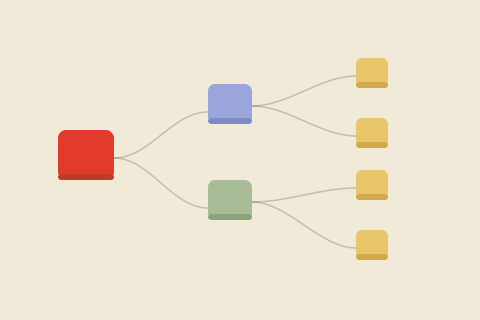
First principles thinking is the opposite move. You break the problem down to the things you know are true, throw away everything you merely inherited, and build your answer back up from what survived.

Where the idea comes from
Aristotle called a first principle "the first basis from which a thing is known." The method is old. The reason it keeps resurfacing is that it is the only reliable way to reach an answer nobody has reached before you — by definition, you cannot copy your way somewhere new.
The modern retelling is usually the battery one. Batteries "cost $600 per kilowatt-hour and always will" was an argument from analogy: they had always cost that, so they always would. Priced by raw materials instead — the carbon, nickel, aluminium, and polymers on the commodity market — the floor turned out to be a fraction of it. Same facts, different starting point.
The method
- State the problem plainly. In one sentence, without the vocabulary of the solution you already have in mind.
- List what you're assuming. Everything you believe about the problem that you have not personally verified.
- Challenge each assumption. For every one: how do I know this is true? If the answer is "everyone knows" or "that's how it's done," it is not a fact.
- Rebuild from what survived. Reason forward from only the assumptions that held.
Step three is where the work is. The other three are bookkeeping.
Breaking a problem down to what is actually true needs a block of attention, not five spare minutes between meetings. Porotimer protects one on your iPhone.
Download on the App Store
What it looks like in practice
A focus app needs a 25-minute timer, because Pomodoro is 25 minutes and every focus app has one.
A focus app needs to protect a block of attention. How long that block should be is a question about the person and the task, not about a kitchen timer.
The analogy answer inherits a constraint nobody checked. The first-principles answer asks what the timer is for — protecting a block of attention from interruption — and notices that the right length is whatever matches the person's actual attention span and the task in front of them. Which is how you end up with configurable sessions instead of a number from a 1980s kitchen timer.
First principles thinking is expensive. Use it where the inherited answer is load-bearing, not on every decision.
When to reach for it
Reserve it for the decisions that compound: the ones where being wrong costs you for years, or where everyone in your market has quietly agreed on something nobody re-checked. For everything else, reasoning by analogy is not laziness — it is an efficient use of other people's verified work.
If your problem is that you know what to do and cannot make yourself start, this is the wrong tool. That is an execution problem, and Eat That Frog is a better fit.
Try it on something real
More mental models

The event is the tip. Underneath sit the patterns, structures and beliefs producing it — and those are the only levers that change anything.

Instead of asking how to succeed, ask what would guarantee failure — then avoid that. The negative answer is usually far more concrete.
Ask what happens after what happens. Most bad decisions look good one step out and fall apart at step two.