
Situation-Behavior-Impact
CommunicationFeedback that lands: name the situation, describe the behaviour, then say the impact. No labels, no guesses about character.
Most feedback fails in the same way. It arrives as a verdict about the person — "you're disorganised", "you're not a team player" — and the listener spends the conversation defending their character instead of considering the point.
Situation-Behavior-Impact, developed at the Center for Creative Leadership, is a three-part sentence that makes that failure hard: it forces you to say when it happened, what you observed, and what it caused, without ever saying what kind of person you think they are.
The three parts
- Situation — when and where, precisely. "In yesterday's planning call…" Anchoring it stops the conversation becoming about always and never.
- Behaviour — what you actually observed, as a camera would record it. "…you cut in twice while Ana was describing the migration…" Not "you dominated", which is a judgement wearing a verb's clothes.
- Impact — what followed, for you or the work. "…so we moved on without hearing the risk she had found." This is the part that makes it matter, and the part people leave out most.
The order does real work. Leading with impact sounds like an accusation; leading with behaviour without a situation sounds like a pattern claim you cannot support.
Difficult feedback goes better when you are not half-reading messages. Porotimer keeps a block clear on your iPhone — timer, breaks, and a distraction shield.
Download on the App Store
What it looks like in practice
"You're careless with reviews. You need to take them more seriously."
Nothing here can be verified, agreed with, or acted on — only accepted or resisted, and most people resist.
"On Tuesday's PR, you approved it in under a minute. The migration shipped without the rollback step, and we lost an hour restoring it."
Every clause is checkable, and the fix is obvious without being stated.
Notice what the second version does not contain: any theory about why. You describe what happened and stop. The other person supplies the reason, which is both more accurate than your guess and much easier for them to say.
It works just as well for praise, and praise is where people skip the impact most. "Good job on the docs" costs nothing; "the setup section meant the new starter shipped on day one" tells them exactly what to do again.
When to reach for it
Reach for it whenever feedback concerns someone's behaviour rather than an artefact — and especially when you are annoyed, because that is precisely when labels come easily and specifics do not.
It pairs with second-order thinking when the impact is not immediate: the effect worth naming is often one step past the obvious one. And if you find yourself unable to name a concrete behaviour at all, that is useful information — the objection may be about a preference rather than a problem, and first principles thinking is a better place to start than a conversation.
More mental models

Strip a problem to what you know is true, then build your answer back up from there.
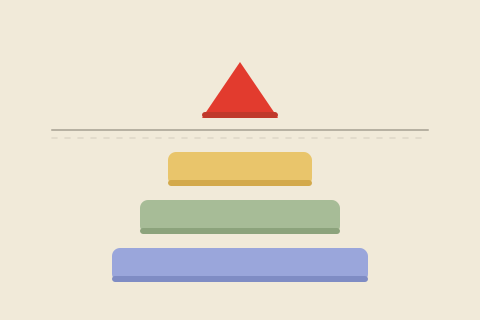
The event is the tip. Underneath sit the patterns, structures and beliefs producing it — and those are the only levers that change anything.

Instead of asking how to succeed, ask what would guarantee failure — then avoid that. The negative answer is usually far more concrete.