Habit Stacking: Build Productive Habits That Actually Stick
Learn the proven habit stacking technique to build lasting productive habits by linking new behaviors to existing routines.
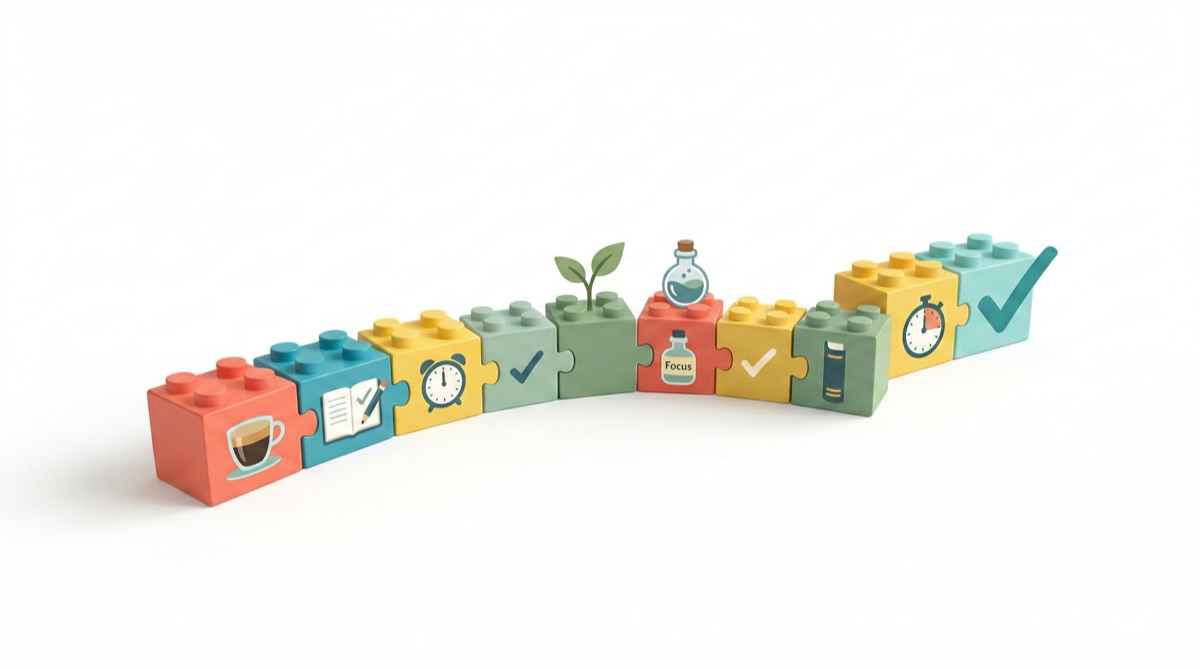
Most people fail at building new habits not because of lack of motivation, but because of lack of a system. Habit stacking — linking a new habit to an existing one — is one of the most reliable methods for making behaviors automatic.
What is Habit Stacking?
Popularized by James Clear in "Atomic Habits," habit stacking uses the formula:
After I [CURRENT HABIT], I will [NEW HABIT].
The idea is simple: your existing habits already have strong neural pathways. By attaching a new behavior to an established one, you leverage that existing wiring instead of building from scratch.
Why It Works
Neural Efficiency
Your brain is a pattern-matching machine. When you pair a new action with an existing trigger, the brain quickly learns the sequence. Over time, the new habit becomes as automatic as the old one.
No Willpower Required
Traditional habit advice says "just be disciplined." But willpower is a limited resource. Habit stacking removes the need for motivation by making the behavior triggered automatically by context.
Clear Triggers
The most common reason habits fail is vague intentions. "I'll exercise more" has no trigger. "After I pour my morning coffee, I'll do 10 push-ups" does.
Productivity Habit Stacks
Here are practical examples for building a more productive day:
Morning Stack
- After I pour my coffee, I will write my top 3 priorities for the day
- After I write my priorities, I will start my first Pomodoro session
- After I complete my first Pomodoro, I will stand up and stretch for 2 minutes
Work Session Stack
- After I sit down at my desk, I will close all non-essential browser tabs
- After I close my tabs, I will open Porotimer and start a session
- After I finish a Pomodoro, I will log what I accomplished
End-of-Day Stack
- After I complete my last Pomodoro, I will review what I accomplished today
- After I review my day, I will write tomorrow's top 3 priorities
- After I write tomorrow's priorities, I will close my laptop
How to Build Your Own Stacks
Step 1: List Your Current Habits
Write down behaviors you already do every day without thinking:
- Brushing your teeth
- Making coffee
- Eating lunch
- Checking email
- Sitting down at your desk
Step 2: Choose Small New Habits
Start tiny. The new habit should take less than 2 minutes. You can always expand later.
Step 3: Link Them
Use the formula: "After I [CURRENT HABIT], I will [NEW HABIT]."
Step 4: Be Specific
- Bad: "After work, I'll plan tomorrow"
- Good: "After I close my laptop at 5:30 PM, I'll write 3 priorities for tomorrow in my notebook"
Common Mistakes
Stacking Too Many at Once
Don't try to build a 10-step morning routine from day one. Start with one stack. Once it's automatic (usually 2–3 weeks), add another.
Making the New Habit Too Big
"After coffee, I'll work out for an hour" will fail. "After coffee, I'll put on my workout shoes" is much more likely to succeed.
Choosing Weak Triggers
Attach new habits to strong, consistent habits — things you do every single day without fail.
Conclusion
Building productive habits doesn't require superhuman discipline. It requires a system. Habit stacking gives you that system by connecting new behaviors to the routines you already have. Pick one stack, start today, and let consistency do the rest.
Build your daily focus habit with Porotimer.