Digital Minimalism: Declutter Your Digital Life to Boost Productivity
Learn how reducing digital noise and distractions can dramatically improve your focus, productivity, and mental clarity.
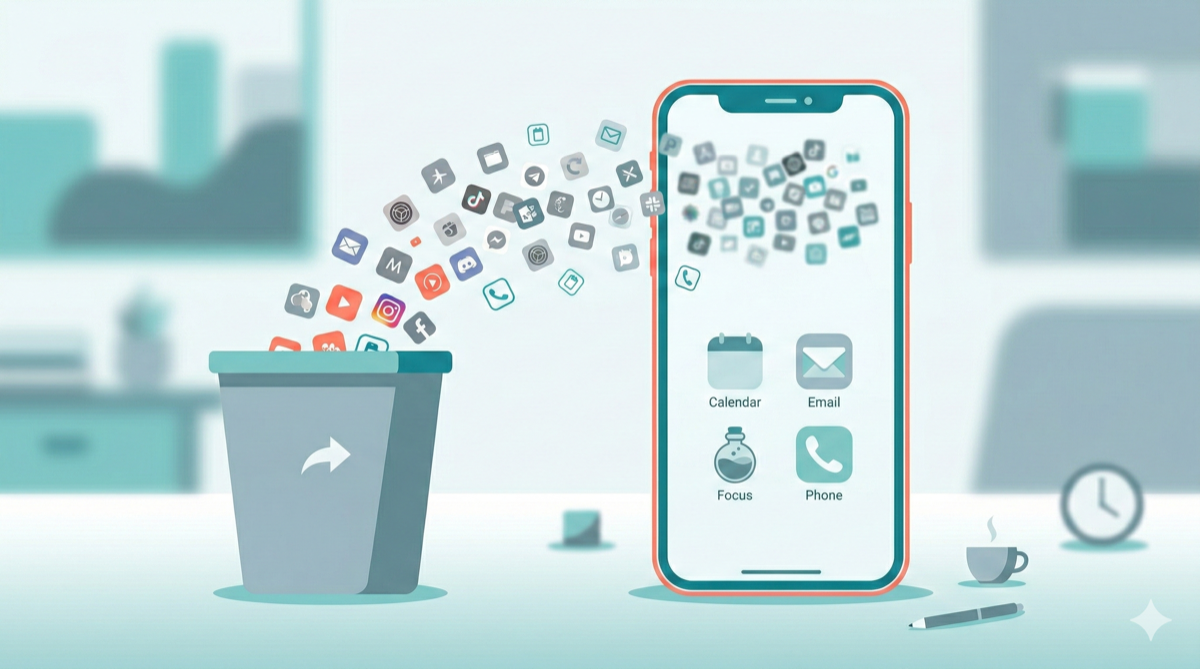
The average person checks their phone 96 times a day and spends over 7 hours on screens. Much of this time is spent on things that add little value — mindless scrolling, unnecessary notifications, and app-hopping. Digital minimalism is about intentionally choosing which technologies serve you and eliminating the rest.
What is Digital Minimalism?
Coined by Cal Newport, digital minimalism is a philosophy where you focus your online time on a small number of carefully selected activities that strongly support things you value, and then happily miss out on everything else.
It's not about rejecting technology — it's about being intentional with it.
The Hidden Cost of Digital Clutter
Attention Residue
Every time you switch apps or check a notification, a piece of your attention stays behind. Research by Sophie Leroy found that this "attention residue" significantly reduces performance on the next task.
Decision Fatigue
More apps, more feeds, more inboxes means more micro-decisions throughout the day. Each one depletes the same mental energy you need for important work.
Constant Partial Attention
When your phone buzzes every few minutes, you never fully engage with anything. You're always partially distracted, which prevents deep focus.
How to Practice Digital Minimalism
Step 1: Audit Your Digital Life
For one week, track how you use your devices:
- Which apps do you open most?
- How much time do you spend on social media?
- How many notifications do you receive daily?
- Which tools genuinely help you work?
Step 2: Apply the Three-Question Filter
For each app and digital tool, ask:
- Does this directly support something I deeply value?
- Is this the best way to support that value?
- How can I use this with constraints to maximize benefit and minimize harm?
Step 3: Declutter
- Delete apps you haven't used in 30 days
- Unsubscribe from newsletters you don't read
- Turn off all non-essential notifications
- Remove social media apps from your phone (use the browser instead)
- Clean up your desktop and downloads folder
Step 4: Set Digital Boundaries
- Phone-free zones: No phones at the dinner table or in the bedroom
- Batch communication: Check email/messages only 2–3 times per day
- Screen-free mornings: No screens for the first 30–60 minutes after waking
- Scheduled social media: If you use it, set specific times (e.g., 15 min at lunch)
Step 5: Replace with Analog Alternatives
- Use a physical notebook for brainstorming
- Read physical books instead of scrolling
- Use a whiteboard for planning
- Have face-to-face conversations when possible
Digital Minimalism + Pomodoro
The Pomodoro Technique pairs perfectly with digital minimalism:
- During a Pomodoro session, put your phone in another room
- Close all tabs except what you need for the current task
- Use a dedicated timer app (like Porotimer) instead of your phone
- Use breaks intentionally — stretch, walk, hydrate — not scroll
Benefits You'll Notice
- Deeper focus during work sessions
- Less anxiety from constant notifications
- More free time from reducing screen hours
- Better sleep from less evening screen time
- Increased creativity from giving your brain space to think
Conclusion
Digital minimalism isn't about going off-grid. It's about reclaiming your attention from the apps and notifications that steal it. Start with one small change — turn off non-essential notifications today — and notice the difference in your focus.
Start a distraction-free focus session with Porotimer.